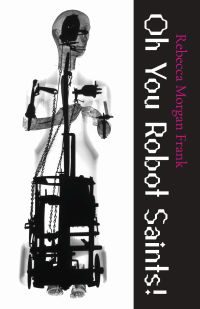
NEW YORK TIMES NEW & NOTABLE POETRY

NEW YORK PUBLIC LIBRARY BEST BOOKS OF 2021

“[Frank] picks at the tension between born and unborn, magic and science, fertility and sterility, the sexed and the sexless, the lifeless, the living, and the never-lived….That she reckons with the machine makes the aliveness of her voice, the heat behind it, all the more evident, and all the more urgent.” THE BOSTON GLOBE

“Eye-opening, jaunty: this is a whirl of a book.” THE MILLIONS

Oh You Robot Saints! amasses many compelling visions and intriguing premises. It also holds out for the human subject’s liberation from technological subjugation by fighting back — HYPERALLERGIC

“The truth is in the job, not the wound” is one of my favorite lines in Rebecca Morgan Frank’s daring Oh You Robot Saints!, a book in which the beauty, jealousy, and worship of the gods take center stage. Part of the precision of this book and every one of its lines has to do with Frank’s commitment to showing us tragedy as the Greeks would through her indomitable use of second person like a director giving instructions: “Fill the ark: start / with the giant flower / beetle . . .” And part of it has to do with full-on Sapphic tenderness: “The women I’ve loved and lived with are dead, / and today it felt like spring might return.” This volume proves Rebecca Morgan Frank is a poet of the exact and the harrowing.” –Jericho Brown

“We had always thought our art would be immortal,” muses the concluding poem of Oh You Robot Saints!, Rebecca Morgan Frank’s timely meditation on the complex work of making. Frank’s book reveals how the many kinds of poiesis we humans commit satisfy similar urges: we build so many lovely machines-out of cutting-edge composites, out of words, out of our own genetic material-each with the craving to expand beyond ourselves, to outrun our frail limits. Frank gazes directly at our compulsion to “build / a body that moves,” offering these poems as a kinetic example of their own argument. “To be true is to be an imitation,” Frank argues; painstaking, handmade, Frank’s clockwork poems strike true.” –Kimberly Johnson

Previous Books

“The gorgeously made poems in The Spokes of Venus suggest the self-reflexivity of the beholder and the nuances of perception: the slippage between object and viewer — whether the site of scrutiny is planet or painting. . . . Whether the object is painting or dance, installations or music, Frank’s elegant, cerebral poems evoke all the senses in richly condensed lines: a syntax that fibrillates with radiant linguistic spokes — insights so fresh that that one can’t help but be amazed and instructed. . . .Ekphrastic art should enrich or extend the work it considers: “A god can see something / that does not yet exist in the world.” Rebecca Morgan Frank’s poems have just that visionary freshness and strength: they share the power of all startlingly beautiful things.” –Alice Fulton

“Rebecca Morgan Frank’s dazzling new collection leaps into the world of art making, inspired at first by the 19th century astronomer Percival Lowell’s absurd insistence that he saw, through his own telescope, canals on the planet Venus—what he was seeing was the reflection of his own veinous eye! From this “creative” mistake, Frank moves into poems in conversations with artists living and dead, poems that turn us upside down and shake the dust of art history out of our pockets. They whirl into their subjects in an irresistible frenzy of language and music.” –Gail Mazur

“In Rebecca Morgan Frank’s remarkable first book, the line that launches a story about feeding an injured raptor morphs hauntingly into ars poetica: “I was the dark room, the leather glove, the rope” . . . .  Captured in this parable are both the ruthless devotion to beauty and the yet-more-ruthless devotion to clear-eyed rendering that make Little Murders Everywhere an extraordinary debut.  The elegant formal variations in these poems, the structuring alliterations, the density and precision of the figurative imagination would almost suffice on their own but, wonderfully, they have no need to do so.  They add up, as in all true poetry, to a way of seeing.” –Linda Gregerson
                     
“Rebecca Morgan Frank’s arresting and unflinching poems show what can still be done with the bittersweet stuff of longing that gave the art of the lyric its original reason for being. Everywhere she turns her rapt attention – pensive elegies and laments, gnomic riffs on things lost and found in the naked city, limber sonnets on nettling sins of the spirit and the flesh – she’s in her element, taking the measure of desire in language honed to a glittering edge. “Go ahead, reinvent the wheel,” one mordant poem here begins, and so she does, daring you to see another soul at the white heat with a mind and music all her own.” –David Barber

“I don’t think I’ve read a book as unapologetically metaphysical as The Spokes of Venus since Heather McHugh’s early work.   One feels everywhere in these poems the force of Morgan Frank’s insistent looking, tensile, witty, fiercely cool in its appraisals: “The truth is that there’s nothing in the room but us.”  Right, there we are—dead center.  Frank gets it, totally: the centripetal forces that whirl us there are awesome.”   –David Rivard

“There’s something tenacious and fierce about this vivid book, with its spinning, Metaphysical metaphors, quick turns of line, and unpredictable, dynamic, monologues in the voices of dispossessed people and things. In this poet’s hands, form means trying anything you can. Sometimes We’re All Living in a Foreign Country’s pages teem with a yearning for change. They live by their nerve in that ghostly small town our vast America can become inside a poem. But Rebecca Morgan Frank does more than withstand her own disorientation in the country she finds she must look at and try to see – she turns it into radar, second sight, an inestimable sixth sense, joining that home-grown company of visionary dissenters (I think of James Wright, or even Larry Levis) who have done the same.” –Katie Peterson

Select Anthologies & Edited Collections